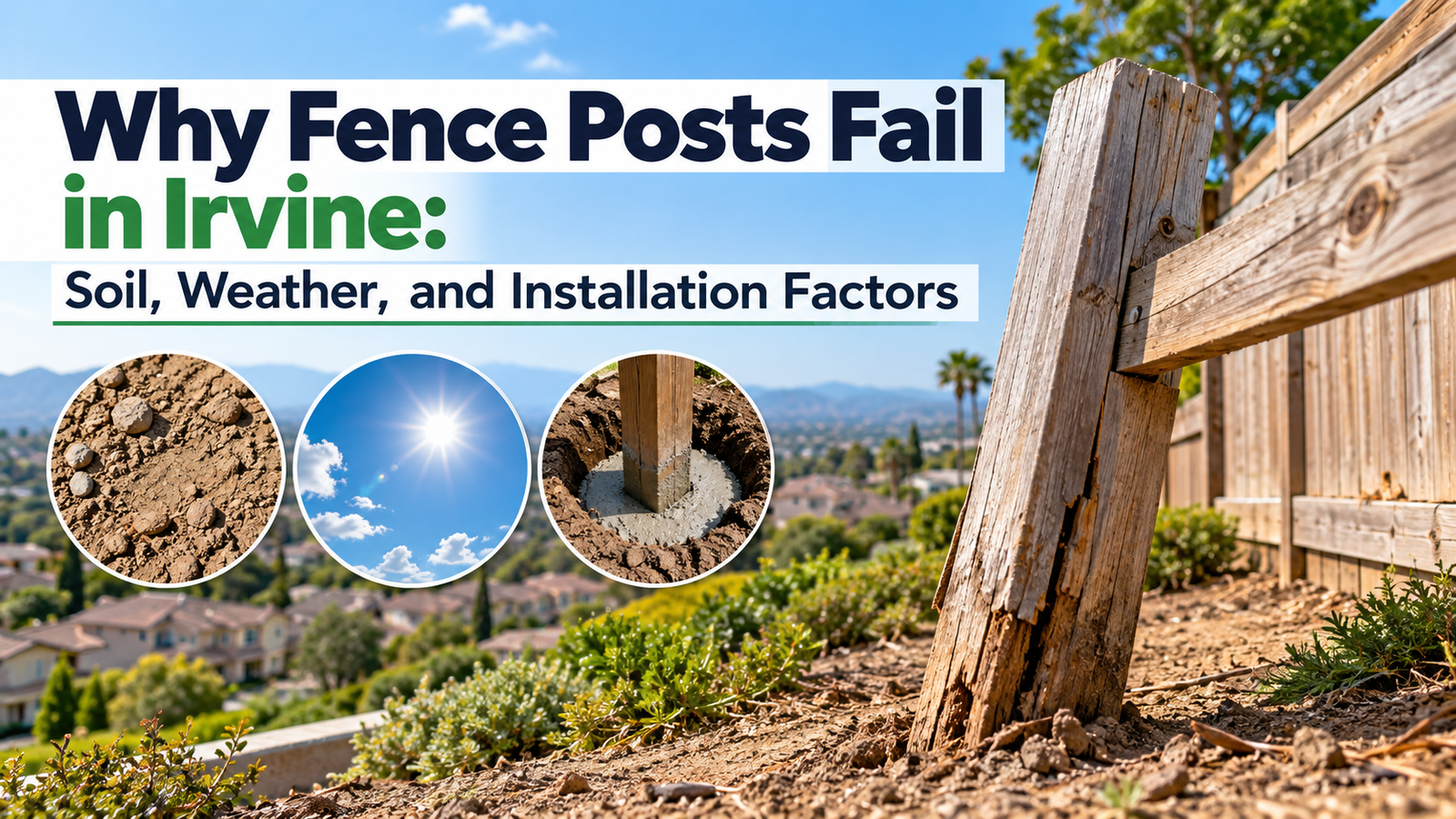
Fence post failure is one of the most common problems that homeowners and property managers encounter with fencing in Southern California and in Irvine specifically, the conditions that cause post failure are different from what drives failures in other parts of the country. Understanding why posts fail in this environment helps property owners recognize early warning signs, make informed choices when installing new fencing, and understand what’s behind any Why Fence Post Fail in Irvine lean, wobble, or collapse they observe.
Irvine’s Soil Conditions and Their Effect on Posts
Irvine sits on the eastern edge of the Los Angeles Basin, on marine terrace soils and alluvial deposits overlying the Santa Ana Mountains’ foothill edge. The dominant soil types in much of Irvine are clay-bearing specifically, soils with montmorillonite clay minerals that have significant shrink-swell behavior. These soils expand when wet and contract when dry, creating a rhythmic movement in the ground that acts on fence posts year after year.
When wet, expansive clay soils exert lateral pressure on fence posts pushing against the post from the sides as the soil swells. When the soil dries out in summer, it contracts and pulls away from the post, leaving gaps around it. This repeated cycle of gripping and releasing, pushing and contracting, gradually loosens the post in the hole and can cause it to shift laterally or begin to lean.
The Southern California Association of Governments and Irvine’s development standards recognize expansive soils as a significant design consideration. The City of Irvine’s standard development conditions require soils reports for most construction projects, and the shrink-swell potential of native and engineered soils is documented in those reports. For fence installations, this means that post depth and concrete encasement specifications must account for the actual soil conditions at the specific site.
Drought-Cycle Effects on Fence Post Stability
California’s climate cycles between wet years and extended droughts, and these cycles affect soil volume and fence post stability in ways that shorter-cycle weather variation does not. During multi-year droughts, clay soils in Irvine can shrink significantly and deeply, creating looseness around posts that were originally set tightly. When drought ends and wet conditions return, soils rewet and may heave posts upward or push them laterally as they re-expand.
Irrigation systems are a complicating factor. Irvine’s heavily landscaped neighborhoods maintain irrigation year-round, which means the soil immediately adjacent to irrigated areas remains wetter than the surrounding unirrigated ground. This creates differential soil moisture and differential soil volume that imposes asymmetric forces on fence posts. A post near an irrigated lawn will experience wetter-side expansion and drier-side contraction that can rotate or tilt the post over time.
Post Material and Decay Failure
Wood fence posts in Irvine fail through biological decay as well as mechanical movement. Pressure-treated lumber the standard for wood fence posts contains preservative compounds that resist fungal decay and insect attack. California’s Title 24 building standards and recent regulatory changes have affected the preservative compounds that can be used in treated lumber, particularly in applications near potable water or sensitive environments.
The most common preservative in current pressure-treated lumber is ACQ (Alkaline Copper Quaternary) or CA (Copper Azole). Both provide good rot resistance but require that fasteners and hardware be specifically rated for use with the preservative standard galvanized hardware can corrode in contact with ACQ-treated wood, accelerating hardware failure even when the wood itself is intact.
In Irvine’s irrigated landscape environment, wood posts set in or near regularly irrigated areas remain moist much of the time an ideal condition for the wood rot organisms that pressure treating is designed to resist. When pressure treatment is inadequate, when treated wood is cut in the field and the cut ends are not treated, or when water collects at the post base above the concrete, decay can still occur.
Steel posts used in wrought iron, ornamental aluminum, and chain link fencing fail through corrosion rather than decay. Orange County’s coastal-influenced air carries salt aerosol inland to Irvine, which accelerates corrosion on unprotected steel. Galvanized and powder-coated steel posts resist corrosion better than bare steel, but damage to the coating from soil movement, rocks, or landscaping activity exposes bare metal to corrosive attack.
Installation Depth and Concrete Encasement
The most preventable cause of fence post failure is inadequate installation depth. A general rule of thumb for fence post installation is to set the post at a depth equal to one-third of the total post length a 6-foot fence typically uses an 8 to 9-foot post set 2.5 to 3 feet deep. In Irvine’s expansive soils, the minimum depth should be at the upper end of or above typical recommendations, and concrete encasement is important to lock the post against lateral movement.
Concrete encasement in expansive clay soils requires attention to detail. A bell-bottom form concrete that is wider at the bottom than the top creates a mechanical anchor that resists pull-out. The concrete should extend above grade on all sides and be sloped away from the post to shed water rather than pooling at the post base. Concrete pooled around a wood post accelerates decay at the most critical point.
Some installers skip concrete entirely and rely on tamped native soil to hold posts. In stable sandy soils, this can work for light fence panels, but in Irvine’s shrink-swell soils, concrete encasement is strongly preferred for any fence expected to remain stable over multiple drought-wet cycles.
Wind Loading in Irvine
Southern California’s Santa Ana wind events impose significant lateral loads on fencing. These offshore wind events, which occur primarily in fall and occasionally in winter, can produce sustained winds of 25 to 40 mph in the Irvine area and gusts well above that in exposed locations. Solid panel fences wood, vinyl, or masonry present full wind surface area and experience much higher wind loads than open-style fences during Santa Ana conditions.
A fence that seemed solid under normal conditions can fail dramatically in a Santa Ana wind event if the posts were set too shallowly, the concrete is deteriorated, or the panels have been damaged by prior movement. Post spacing is a factor: wider post spacing increases the span between supports, which increases the bending moment on each post under wind load. Standard post spacing of 6 to 8 feet is appropriate for most residential applications in Irvine; reducing spacing to 6 feet in exposed locations provides better wind resistance.
Frequently Asked Questions: Fence Post Failure in Irvine
How do I know if a fence post has failed structurally vs. just appearing to lean?
A post that appears to lean but is firm at the base with no movement when pushed may simply have been installed slightly off plumb. A post that rocks or moves when pressure is applied has lost its foundation support, either from soil movement, concrete deterioration, or post decay at the base. The distinction matters: a cosmetically leaning but structurally sound post can sometimes be addressed without full replacement; a post that moves freely needs to be reset.
Can a leaning fence post be fixed without replacing it?
In some cases, a post that has shifted can be repositioned if the post itself is structurally sound and the concrete is still intact. The old concrete is broken out or the post is extracted, repositioned, and re-set with new concrete. If the post has decayed at the base or the concrete has failed, the post must be replaced. Posts that have been leaning for some time may also have caused rail connection damage that needs to be addressed alongside the post repair.
Does Irvine require permits for fence installation?
The City of Irvine requires building permits for fences above certain height thresholds. Standard 6-foot residential fences typically require a permit; decorative lower fences may not. Properties in Irvine’s planned community areas are also subject to HOA rules that govern fence material, style, height, and placement. Fences near property lines, in setback areas, or near sight-distance triangles at intersections are subject to zoning requirements regardless of height. Checking with the City of Irvine Planning Division and the applicable HOA is the right first step before installing or replacing fencing.
What fence materials last longest in Irvine’s climate?
Ornamental aluminum and powder-coated steel are generally the most durable fence materials in Southern California’s environment because they are not subject to wood decay or the shrink-swell damage that affects wood and vinyl panels. Masonry block walls, while more expensive, provide excellent long-term durability with minimal maintenance. For wood fencing, using posts rated for direct burial (UC4B or higher pressure treatment) and maintaining the paint or stain finish extends service life significantly.